
Guide
Water-resistant to 3, 5, 10, 20 bar – what does it really mean?
"Water-resistant to 30 m" – and yet the watch fogs up after swimming? That isn't the manufacturer's fault, but a common misunderstanding. Here you'll learn what the ratings mean and how to protect your watch properly.
Updated 7 min readEditorial team wouhr.de
The misunderstanding about metres
Watch manufacturers state water resistance in bar, ATM (atmospheres) or metres. One bar roughly corresponds to one atmosphere and about ten metres of water column. But "30 m" doesn't mean you can dive to 30 metres with the watch. It is a static test pressure, tested under lab conditions in still water at a constant temperature.
In practice, quite different forces are at work: front crawl, diving in or a powerful jet of water create pressure peaks. Warm shower water makes seals and case expand, and cold water afterwards makes them contract. Soap, shampoo, chlorine and salt attack the seals. That's why watchmakers always interpret the ratings more cautiously than the bare numbers suggest.
The table: what each rating lets you do
The following guidelines are based on the ISO 22810 standard for water-resistant watches and the recommendations of major manufacturers. If in doubt, follow the manual for your model.
- No rating or "Water Resistant" without a number: sweat and splashes only
- 3 bar / 30 m: rain, splashes, hand-washing – no showering or bathing
- 5 bar / 50 m: hand-washing, showering (cold to lukewarm), brief swimming only if the manufacturer allows it
- 10 bar / 100 m: swimming, snorkelling, surface water sports
- 20 bar / 200 m: intensive water sports, snorkelling and freediving; scuba diving only with a dive watch to ISO 6425
- Dive watch to ISO 6425: tested watch for scuba diving, at least 100 m
10-bar watches for swimming & snorkelling
Ad All products linked with "View offer" are commission (affiliate) links: if you buy through them, we earn a commission – the price stays the same for you. As an Amazon Associate and eBay Partner Network affiliate we earn from qualifying purchases. Learn more
 Ad
Ad Ad
Ad Ad
Ad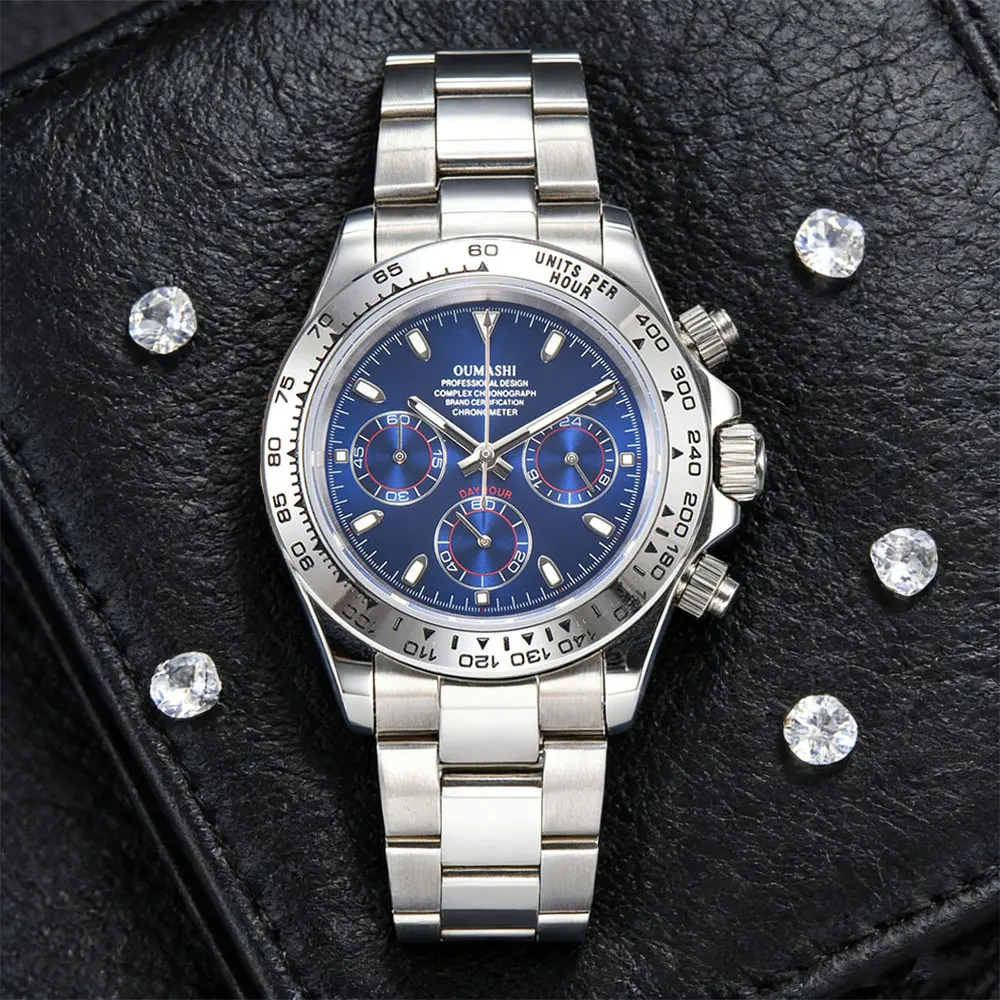 Ad
Ad39mm Silberne Uhr mit VK63 Uhrwerk, Saphirglas, Edelstahlarmband …
Dive watches: the ISO 6425 standard
Dive watches have a standard of their own. Among other things, ISO 6425 requires water resistance of at least 100 metres, tested with an overpressure of 25 per cent; a unidirectional rotating bezel or another way of timing dives; legibility in total darkness from a distance of 25 centimetres; resistance to salt water, magnetic fields and shocks; and a secure strap attachment. In addition, every single watch is tested, not just samples.
Many watches with "diver" styling don't officially meet this standard, but are still sufficiently water-resistant for swimming and snorkelling. For real scuba diving, divers today rely on a dive computer anyway – the dive watch serves as a dependable backup.
20-bar dive watches with rotating bezel
Ad All products linked with "View offer" are commission (affiliate) links: if you buy through them, we earn a commission – the price stays the same for you. As an Amazon Associate and eBay Partner Network affiliate we earn from qualifying purchases. Learn more
 Ad
Ad Ad
Ad Ad
Ad Ad
AdSmartwatches: IP68 and 5 ATM are not the same
Smartwatches and fitness trackers come with two different ratings. The IP rating according to IEC 60529 (such as IP67 or IP68) describes the dust and water protection of electronic devices. A second digit of 7 means brief immersion down to one metre; 8 means immersion under conditions set by the manufacturer – often 1.5 metres for 30 minutes in fresh water. Movement, salt water and chlorinated water aren't taken into account. IP68 is therefore no licence to swim.
The 5 ATM rating, on the other hand, comes from the watch world. Smartwatch manufacturers usually use it to approve surface swimming, but add: not for diving, water skiing, hot water, soap or saunas. So if you want to swim lengths with your smartwatch, look for at least 5 ATM, a swim mode and swim approval in the manufacturer's specifications; some models also offer a water lock that disables the touchscreen in water and pushes water out of the speaker.
Smartwatches with 5 ATM
Ad All products linked with "View offer" are commission (affiliate) links: if you buy through them, we earn a commission – the price stays the same for you. As an Amazon Associate and eBay Partner Network affiliate we earn from qualifying purchases. Learn more
 Ad−10%
Xiaomi Smart Band 10, Smart Watch,Fitness-Tracker, 1,72" AMOLED Display …
 Ad−63%
 Ad−13%
 Ad−11%
Crown, pushers and seals
The weak points of any watch are its openings: crown, pushers, crystal and caseback. A screw-down crown is screwed back down after setting, sealing the case further – if you forget, the stated water resistance doesn't apply. You shouldn't operate chronograph pushers underwater unless the manufacturer explicitly allows it.
Rubber or silicone seals age over time. Manufacturers therefore recommend having the water resistance tested about once a year if you regularly wear the watch in water – and in any case after a battery change or after the case has been opened. At a watchmaker the test usually takes just a few minutes.
For the test, the watchmaker places the watch in a device under overpressure or vacuum and measures whether the case deforms or air escapes. This is done dry and is gentle on the movement. If the watch fails, usually only the seals are replaced – a small effort compared with water damage to the movement.
Care tips for watches in water
A few habits make water resistance last much longer. After swimming in the sea or pool, rinse the watch with clean fresh water and dry it with a soft cloth. Turn rotating bezels while doing so, so that no salt builds up. Leather straps are fundamentally not made for water; rubber, silicone, nylon or stainless steel straps are suitable for swimming and holidays.
Avoid saunas and steam rooms completely: heat and steam are a problem for almost all watches, even high-quality dive watches. If condensation forms under the crystal, take the watch to a watchmaker as quickly as possible, before corrosion damages the movement.
What exactly the standards test
For ordinary water-resistant watches, the international standard is ISO 22810; in Germany, DIN 8310 used to be common. Tests include whether the watch stays watertight when immersed in ten centimetres of water for one hour, whether it withstands an overpressure corresponding to the stated water resistance, and whether condensation forms after temperature changes. Operating the crown underwater can also be part of the test.
Important: not every watch is tested individually. For everyday watches, random samples from production are often enough. Only for dive watches to ISO 6425 does the standard require every single watch to be tested. That's why the rating on an everyday watch should be seen as a guideline for its condition when new.
Typical everyday situations
Many questions about water resistance arise in everyday life. For hand-washing, a watch with 3 bar is enough – as long as you don't hold it under the running tap or submerge it for long. Washing up and cleaning combine detergent, hot water and knocks; here it's better to take off even a robust watch. In the shower, heat, soap and shampoo stress the seals. From 5 bar, cold to lukewarm showers are usually permitted, but many manufacturers advise against regularly wearing the watch in hot showers – check the manufacturer's specifications.
On a beach holiday, sand is an underestimated enemy: it can lodge between the bezel, crown and strap and damage the seals when you operate the crown later. So rinse the watch thoroughly after a day at the beach before you set it. Jumping off the side of the pool or water skiing briefly creates high pressures – at least 10 bar, preferably 20 bar, makes sense for that.
- Hand-washing: from 3 bar, don't submerge
- Showering: from 5 bar, only cold to lukewarm, without much soap
- Pool and sea: from 10 bar (5 bar only briefly and if the manufacturer allows), rinse afterwards
- Jumping in, water skiing: 20 bar recommended
- Sauna and steam room: always take it off
In a nutshell
The number on the dial or caseback is a test value under ideal conditions, not a permitted depth. For everyday life with rain and hand-washing, 3 bar is enough. If you shower cold to lukewarm or briefly go into the water, choose 5 bar and check the manufacturer's specifications; 10 bar is designed for swimming and snorkelling, and for diving you need a dive watch to ISO 6425. Smartwatches rated IP68 are protected against rain and dust; for swimming you need at least 5 ATM and the manufacturer's approval. And no matter how high the rating: seals age. Regular testing by a watchmaker and rinsing after salt or chlorinated water keep your watch watertight for the long term.
FAQ
Can I shower with a 3-bar watch?
Better not. 3 bar only protects against splashes and rain. For showering it should be at least 5 bar, and even then only cold to lukewarm – hot water and soap take their toll on the seals.
Is ATM the same as bar?
Practically, yes. One physical atmosphere corresponds to about 1.013 bar; for watches, both ratings are used interchangeably.
Why is my watch fogging up on the inside?
Moisture has got in, usually through aged seals, an open crown or temperature changes. Take the watch to a watchmaker promptly, before the movement corrodes.
Is IP68 enough for swimming?
No. IP68 describes still immersion under lab conditions. For swimming, look for at least 5 ATM and explicit approval in the manufacturer's specifications.
How often should I have the water resistance tested?
About once a year with regular water contact, and always after a battery change or repair.