
Reklama

Zegarki automatyczne
Porównanie: Zegarek
Mechanika bez baterii: zegarki automatyczne nakręcają się ruchem ręki. Porównaj tu modele z japońskimi, chińskimi i szwajcarskimi mechanizmami.
Seiko Herren Analog Automatik Uhr mit Edelstahl Armband SRPH87K1, SilberSeiko · Srebrny · Automatyczny252,50 € Seiko Herren-Uhr Automatik Edelstahl mit Edelstahlband SRPH89K1Seiko · Automatyczny · Męskie253,16 €
 Tissot Herren Analog Automatik Armbanduhr Seastar 1000Tissot · Automatyczny · Męskie568,26 €
 Tissot Damen Analog Automatik Armbanduhr PRX Swiss MadeTissot · Automatyczny · Tissot PRX535,07 €
 Tissot Herren Analog Automatik Armbanduhr Seastar 2000 Swiss MadeTissot · Automatyczny · Męskie767,17 €
 Tissot Herren Chronograph Automatik Armbanduhr PRX Swiss Made …Tissot · Automatyczny · Tissot PRX1349,00 €
 Seiko 5 Sport Limited Edition SRPL03K1 1968 Re-Edition Men's Automatic …Seiko · Automatyczny · Seiko 5414,95 €
 Tissot Herren Analog Automatik Armbanduhr Gentleman Powermatic 80 Swiss …Tissot · Automatyczny · Męskie919,05 €
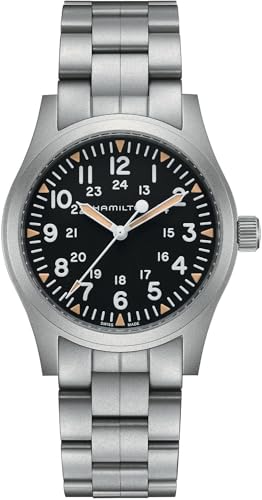 Hamilton Herren Analog Handaufzug Armbanduhr Khaki Field MechanicalHamilton · Brązowy · Naciąg ręczny865,00 €
 JUNGHANS max Bill Armbanduhr Handaufzug mit Saphirglas 27/3701.02JUNGHANS · Naciąg ręczny · Junghans max bill1145,00 €
Amazon (Jewels & Watches Company)Reklama
Amazon (Jewels & Watches Company)Reklama
Amazon (Jewels & Watches Company)Reklama
Amazon (Chronographen24)Reklama
Amazon (Conquest GmbH)Reklama
Amazon (solarcosa)Reklama
Amazon (LUN since1962)Reklama
Nowe, używane i odnowione – oddzielnie od porównania sklepów, ceny maks. sprzed 6 godzin.
eBay (agwatchshop)Reklama
eBay (cw_timede)Reklama
Zegarki automatyczne
Zegarki automatyczne
Inside sits a mechanical movement with a mainspring, gear train, escapement and balance wheel. A semicircular rotor turns with every movement of your wrist and winds the spring. The stored energy is called the power reserve – around 40 hours for most movements, and 70 to 80 hours for modern calibres. If you take the watch off for longer, it stops and has to be reset. Hand-wound watches work in a similar way but have no rotor: you wind them regularly via the crown.
Many affordable automatic watches run on the Seiko calibre NH35 (or the NH36 with a day display). It has 24 jewels, beats at 21,600 vibrations per hour, offers around 41 hours of power reserve, hacking seconds and hand-winding. The manufacturer's accuracy rating is roughly −20 to +40 seconds per day – in practice many examples run better. Equally widespread are Miyota movements from Citizen (e.g. the 8215 or 9015) and Chinese calibres from Seagull. In more expensive watches you'll find Swiss movements such as the ETA 2824-2 or Sellita SW200.
A display caseback shows the movement – nice to look at, but it says nothing about quality. Skeleton dials are a design feature; in very cheap watches, the movement behind them is often simply finished.
Automatic watches don't like strong magnetic fields – don't put them directly on speakers, tablets with magnetic covers or wireless chargers. Hard knocks, for example when playing tennis or hammering, can strain the balance wheel. If you wear several automatic watches in rotation, you can use a watch winder, but it isn't necessary. Also check the water resistance: many automatic watches with a display caseback offer 3 to 5 bar; for swimming, 10 bar and a screw-down crown are the safe choice.
Proste mechanizmy jak NH35 według producenta odchylają się do −20/+40 sekund na dobę, w praktyce często mniej. Certyfikowane chronometry osiągają −4/+6 sekund na dobę.
Chodzi, dopóki wystarcza rezerwa chodu – zwykle ok. 40 godzin – potem staje. Po prostu nakręć go kilka razy koronką i ustaw godzinę.
Nie. Rotomat jest wygodny, jeśli masz kilka automatów i chcesz je nosić bez przestawiania, ale do działania zegarka nie jest potrzebny.
Uchodzi za solidny, popularny mechanizm podstawowy Seiko (TMI) z ręcznym naciągiem i stop-sekundą. Części i serwis są łatwo dostępne.
Producenci zalecają zwykle przegląd co pięć–dziesięć lat. Najpóźniej gdy zegarek wyraźnie traci dokładność lub spada rezerwa chodu, warto odwiedzić zegarmistrza.